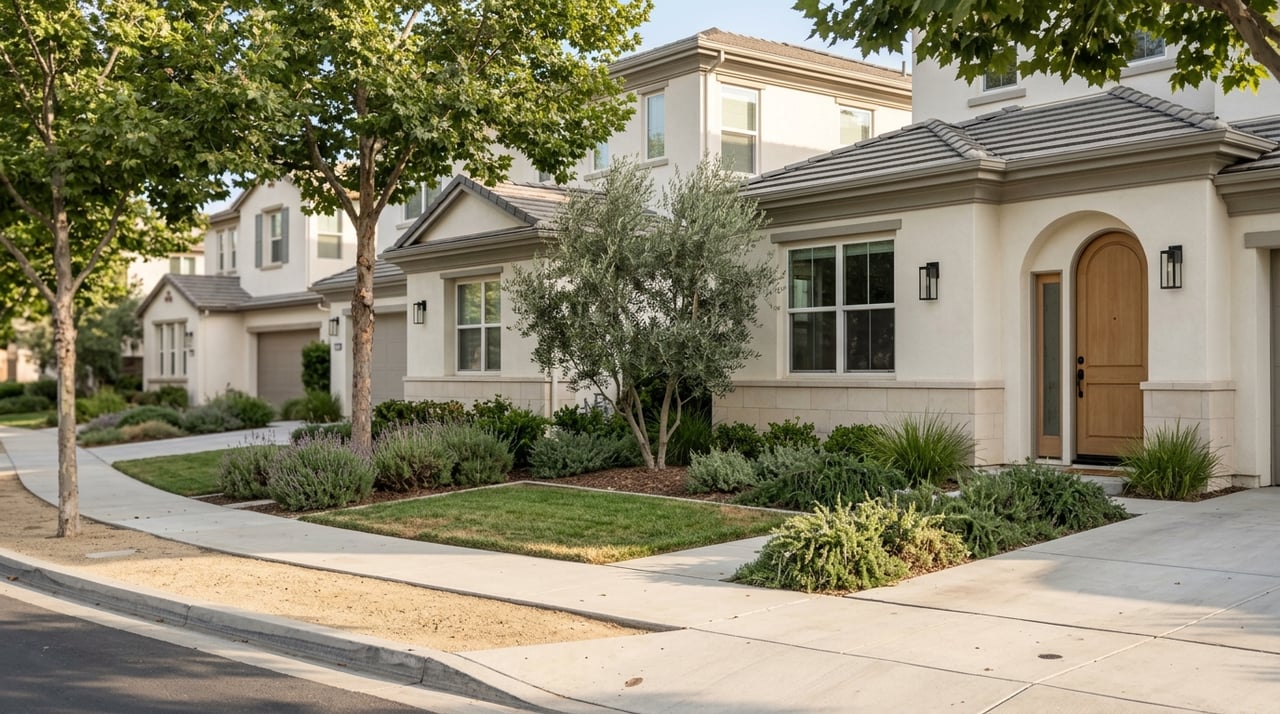
Are you looking at Mountain House and wondering why it feels so different from many other Bay Area-adjacent communities? That difference is not accidental. Mountain House was planned from the ground up, and that master-planned design shapes everything from home values and amenities to resale competition and homeowner expectations. If you want to understand how the market works here before you buy or sell, this overview will help you see the bigger picture. Let’s dive in.
Why Mountain House Feels Different
Mountain House did not grow in the same way as many older suburban cities. Its planning documents describe a self-sufficient community organized into 12 neighborhoods with parks, schools, small commercial areas, and a projected full buildout of about 44,000 residents, 16,000 dwelling units, and about 21,000 jobs.
That long-range structure matters in the market. As of April 1, 2025, the city reported 9,045 residential permits issued and 8,467 finalized, with 7,755 primary units still left to be permitted. That means Mountain House is not just a resale market. It is also a market still shaped by ongoing development.
Mountain House also became an incorporated city on July 1, 2024. So today, buyers and sellers are navigating a place that sits between a long-established master plan and a relatively new city government.
How the Master Plan Shapes Daily Life
The original design for Mountain House was very intentional. Neighborhoods were planned around a school, a park, and a small commercial site, with a pedestrian-scaled layout and a trail network connecting key destinations.
The broader vision also included village centers, a mixed-use Town Center, and open space along Mountain House Creek. In practical terms, that means many of the features people notice here are part of one connected plan rather than separate projects added over time.
For you as a buyer or seller, this creates a different kind of appeal. Mountain House often attracts people who want a more predictable layout, newer homes, and shared community spaces woven into everyday life.
Why Location Inside Mountain House Matters
In some cities, one subdivision can feel much like the next. In Mountain House, location within the community can carry more weight because the neighborhoods were planned around shared destinations and attendance patterns.
The master plan designated a K-8 school at the center of each of the 12 proposed neighborhoods, with nearby parkland intended for both school and neighborhood recreation use. Mountain House High School is the district’s first and only planned comprehensive high school, and Lammersville Unified School District lists Mountain House High School along with elementary schools including Cordes, Questa, Costa, Wicklund, and Hansen.
That does not mean one area is universally better than another. It does mean buyers often pay closer attention to proximity to parks, trails, schools, and village amenities because those features were built into the identity of each part of the community.
Amenities Support the Market
Mountain House’s amenities are spread across the villages rather than concentrated in just one spot. According to the city, each neighborhood has its own five-acre Village Park, some villages have additional neighborhood parks, Creek Park offers hiking trails, and Central Park includes a ball field, basketball court, bocce courts, tennis courts, picnic areas, and a water feature.
That setup can support buyer demand because people are not only evaluating the house itself. They are also considering how the surrounding parks, trails, and community spaces fit into daily routines.
It is also helpful to understand that many of these amenities are public or city-run spaces, not just private HOA features. That makes Mountain House different from communities where lifestyle value depends mostly on a private clubhouse or gated amenity package.
What Buyers Should Know About Ownership Rules
One of the biggest differences in Mountain House is how much structure comes with ownership. Buyers receive Master Restrictions and CC&Rs that are meant to help keep neighborhoods attractive, safe, and consistent.
These documents do more than set general expectations. They also establish a Design Review Committee process, which means exterior changes are often not entirely up to the homeowner.
According to the governing documents, approval may be required for items such as:
- Construction or reconstruction
- Exterior alterations
- Landscaping visible from streets or open areas
- Solar installations
- Accessory buildings
- Drainage changes
- Utility line work
This is important if you are comparing Mountain House to a more conventional subdivision in an older city. If you value a consistent neighborhood appearance, that structure may feel like a benefit. If you want wide freedom to make visible exterior changes quickly, it is something you need to review carefully before buying.
Monthly Costs Can Be More Layered
In Mountain House, ownership costs may involve more than a mortgage, insurance payment, and standard HOA dues. San Joaquin LAFCo describes the Mountain House Community Services District as having 18 legal powers, including water, wastewater, stormwater, garbage, road maintenance, park and recreation services, flood control protection, and CC&R enforcement.
The city finance department also notes special taxes and utility billing responsibilities. For you, that means the monthly cost of owning a home here can be more layered than it first appears.
This does not make Mountain House better or worse than another option. It simply means buyers should look closely at the full cost structure tied to a specific property so they can make a fair comparison.
Why the Housing Stock Feels Consistent
Mountain House has a housing profile that is more uniform than many older Bay Area communities. The city’s 2026 Existing Conditions Report lists 85.0% single-detached units, 7.5% single-attached units, 2.0% two-to-four or five-plus unit buildings combined in the published summary, and 4.2% mobile homes.
That helps explain why so much of the market feels centered on newer single-family homes. If you are shopping here, you may notice less variation in home age and style than you would in a more mature city with decades of layered development.
For sellers, this consistency can be helpful and challenging at the same time. Comparable homes may be easier to identify, but buyers may become more focused on details like floor plan, lot orientation, condition, builder phase, and proximity to parks or schools.
How Master-Planned Living Affects Resale
Resale in Mountain House does not happen in a vacuum. Because the city still has thousands of primary units left to be permitted, resale sellers may compete not only with other homeowners but also with ongoing builder inventory.
That can shape pricing strategy and presentation. When buyers can compare a resale home with newer or upcoming inventory nearby, sellers often need to pay close attention to condition, upgrades, and how clearly the home stands out within a fairly uniform housing pool.
For buyers, this can create more options. For sellers, it raises the importance of timing, preparation, and realistic market positioning.
Price Positioning in the Region
Mountain House occupies an interesting middle position when you compare it with nearby cities. Census QuickFacts shows a median owner-occupied home value of $946,900 in Mountain House, compared with $699,000 in Tracy and $1,105,600 in Livermore.
That makes Mountain House more expensive than a lower-cost exurban alternative, while still below a more established East Bay market like Livermore. It can appeal to buyers who want newer housing and a planned community feel, but who are still weighing value against other nearby choices.
The city’s FY 2025 ACFR also reports 28,795 residents, 8,108 housing units, and a median home sales price of $1.01 million. Census QuickFacts further reports a 69.9% owner-occupied rate, median monthly owner costs with a mortgage of $3,901, and a mean travel time to work of 49.6 minutes.
Predictability Versus Organic Character
The clearest tradeoff in Mountain House is predictability versus organic character. The community offers newer homes, planned amenities, connected parks and trails, and a governance structure that creates a more consistent look and feel.
By contrast, older nearby cities are shaped more by history and gradual growth. Tracy’s official city pages highlight its railroad and agriculture history, while Livermore emphasizes its 1869 founding and historic downtown renaissance.
If you are choosing between Mountain House and an older city, the question is often less about which one is best and more about which lifestyle pattern fits you. Some buyers prefer the structure, newer homes, and shared planning of Mountain House. Others prefer the variety, older housing mix, and more organic street character found in mature communities.
What This Means for Buyers and Sellers
If you are buying in Mountain House, it helps to look beyond square footage and finishes. You also want to understand the neighborhood layout, proximity to parks and schools, ownership rules, and the full monthly cost picture tied to the property.
If you are selling, it is important to know that buyers in this market often compare homes very carefully because the housing stock is relatively similar. Presentation, pricing, and a clear understanding of how your home fits against both resale and builder competition can make a real difference.
Mountain House is not just a place with newer homes. It is a market shaped by a master plan, and that plan still influences value, buyer expectations, and resale strategy today.
If you are weighing a move in or around the Tri-Valley and want calm, informed guidance on how a community like Mountain House fits into your goals, reach out to Ranon Lanners for a thoughtful conversation.
FAQs
How does master-planned living affect Mountain House home values?
- Master-planned living can support value by pairing homes with planned parks, trails, schools, and shared neighborhood design, while also making buyers more sensitive to details like location within the community, condition, and nearby builder inventory.
What should buyers review before purchasing a home in Mountain House?
- Buyers should review the property’s CC&Rs, Master Restrictions, possible design approval requirements, special taxes, utility responsibilities, and how the home fits within the neighborhood’s parks, schools, and amenities.
Why does Mountain House feel different from Tracy or Livermore?
- Mountain House was designed as a connected master-planned community with neighborhood centers, while Tracy and Livermore developed over time with more historic and organic growth patterns.
Are Mountain House amenities private HOA features?
- Many of the parks, trails, and recreation spaces highlighted by the city are public or city-run amenities rather than private HOA-only features.
Does Mountain House still have new construction competition?
- Yes. As of April 1, 2025, the city reported thousands of primary residential units still left to be permitted, which means resale homes may still compete with ongoing builder inventory.
What type of housing is most common in Mountain House?
- The city’s 2026 Existing Conditions Report shows that single-detached homes make up the large majority of the housing stock, which contributes to the community’s newer and more uniform feel.
